> ## Documentation Index
> Fetch the complete documentation index at: https://support.nectir.io/llms.txt
> Use this file to discover all available pages before exploring further.
# Advanced Features
> Advanced features and configurations for Nectir AI Assistants.
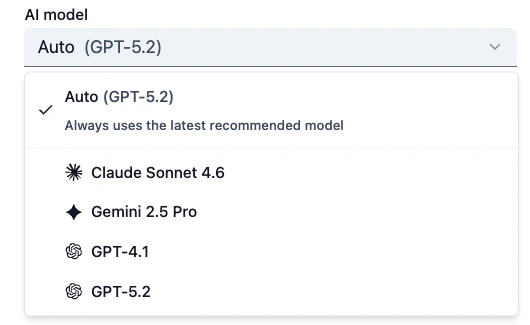 The model picker interface may change as providers and model options evolve over time.
## Configuring AI Models
Nectir gives you control over which AI model powers your Assistant. For most users, the default setting is the best choice.
### Auto (Recommended)
New Assistants default to **Auto**, which always uses the current recommended model. When we update or add models, Auto keeps your Assistant on the best available option without any action from you.
**Use Auto if you:**
* Want your Assistant to always use the latest recommended model
* Don't have a specific reason to choose a different model
* Manage multiple Assistants and don't want to track model changes across all of them
### Choosing a Specific Model
You can also select a specific AI model from the dropdown. Nectir offers models from multiple providers, and the available options may change over time as new models are released.
**You might choose a specific model if you:**
* Want consistent behavior from a particular model you've already tested
* Are comparing how different models respond to the same prompts
* Have a preference based on your own experience with a specific provider
If you select a specific model and it's later removed from the platform, your Assistant will automatically switch to the current recommended model.
### Selecting an AI Model
1. Navigate to your Assistant's settings
2. Click on **Advanced** in the settings sidebar
3. Under **AI Model**, choose **Auto** (recommended) or select a specific model from the dropdown
### Building AI Literacy
Exposing students to different AI models is a practical way to build AI literacy. Because Nectir offers models from multiple providers, you can encourage students to:
* Compare how different models respond to the same question
* Notice differences in tone, depth, and reasoning style across models
* Think critically about which model handles certain types of tasks more effectively
This kind of hands-on comparison helps students develop judgment about AI tools they'll encounter beyond your classroom.
## AI Model Temperature
Temperature controls how creative or focused your AI Assistant's responses are. Most Assistants work well with the default setting. You rarely need to change it, and some models don't support it at all.
The Temperature control always appears in Advanced settings, but it may be disabled for models that don't support it.
Lower Temperature for more consistent, grounded responses (useful for fact-heavy subjects). Raise it for brainstorming or creative work where varied ideas are helpful.
## Web Search
Web search allows your Assistant to search the internet in real-time to answer questions that require current information, recent events, or data beyond the Assistant's knowledge base.
| Web Search Enables ✓ | Web Search Isn't ✗ |
| ----------------------------------------------------------- | -------------------------------------------------------------------------- |
| Real-time internet searches during conversations | URL training or web scraping to add to your Assistant's knowledge base |
| Access to current information and recent events | A replacement for uploading course materials |
| Answers about topics not covered in your uploaded documents | Controlled by knowledge scope settings - it's a separate, independent tool |
| Up-to-date statistics, news, and data | Permanent knowledge that persists across conversations |
**Important**: Web search operates independently of your knowledge scope settings. Even if your Assistant is set to "Document Only," enabling web search allows it to search the internet when needed. The knowledge scope only controls what the Assistant uses its base knowledge (Uploaded Documents and AI Models), not whether it can perform web searches.
Enable web search for Assistants that need to:
* Answer questions about current events or recent developments
* Provide up-to-date statistics, prices, or data
* Research topics not covered in your course materials
* Verify or supplement information with external sources
* Help students explore topics beyond your uploaded content
"How do recent archaeological discoveries about Roman engineering relate to what we learned about their social structure in Chapter 3?"
"Compare today's unemployment data with the economic theories we studied. Which model best explains current trends?"
"Analyze recent CRISPR breakthroughs using the ethical framework from our readings. What new considerations arise?"
"How do current market conditions for tech companies align with Porter's Five Forces model we discussed?"
Consider disabling web search if:
* Your course should focus on uploaded materials
* You want to prevent students from relying on external sources
* Your subject matter doesn't require current information
* You're concerned about external information conflicting with course content
When you enable web search, students interact with the Assistant normally. The Assistant automatically determines when a web search would be helpful and performs it in the background.
**Student Question**: "How does this week's Supreme Court decision on environmental law relate to the regulatory frameworks we studied in Chapter 5?"
| With Web Search ✓ | Without Web Search ✗ |
| ------------------------------------------------------------------------------------------------------------------------------------------------------------------------------------------------------------------------------------------------------------------------------------------------------------------------------------------------------------------------------------------------------------ | ------------------------------------------------------------------------------------------------------------------------------------------------------------------------------------------------------------------------------------------------ |
| "Based on today's Supreme Court ruling, here's how it connects to the Clean Air Act framework we studied:
The model picker interface may change as providers and model options evolve over time.
## Configuring AI Models
Nectir gives you control over which AI model powers your Assistant. For most users, the default setting is the best choice.
### Auto (Recommended)
New Assistants default to **Auto**, which always uses the current recommended model. When we update or add models, Auto keeps your Assistant on the best available option without any action from you.
**Use Auto if you:**
* Want your Assistant to always use the latest recommended model
* Don't have a specific reason to choose a different model
* Manage multiple Assistants and don't want to track model changes across all of them
### Choosing a Specific Model
You can also select a specific AI model from the dropdown. Nectir offers models from multiple providers, and the available options may change over time as new models are released.
**You might choose a specific model if you:**
* Want consistent behavior from a particular model you've already tested
* Are comparing how different models respond to the same prompts
* Have a preference based on your own experience with a specific provider
If you select a specific model and it's later removed from the platform, your Assistant will automatically switch to the current recommended model.
### Selecting an AI Model
1. Navigate to your Assistant's settings
2. Click on **Advanced** in the settings sidebar
3. Under **AI Model**, choose **Auto** (recommended) or select a specific model from the dropdown
### Building AI Literacy
Exposing students to different AI models is a practical way to build AI literacy. Because Nectir offers models from multiple providers, you can encourage students to:
* Compare how different models respond to the same question
* Notice differences in tone, depth, and reasoning style across models
* Think critically about which model handles certain types of tasks more effectively
This kind of hands-on comparison helps students develop judgment about AI tools they'll encounter beyond your classroom.
## AI Model Temperature
Temperature controls how creative or focused your AI Assistant's responses are. Most Assistants work well with the default setting. You rarely need to change it, and some models don't support it at all.
The Temperature control always appears in Advanced settings, but it may be disabled for models that don't support it.
Lower Temperature for more consistent, grounded responses (useful for fact-heavy subjects). Raise it for brainstorming or creative work where varied ideas are helpful.
## Web Search
Web search allows your Assistant to search the internet in real-time to answer questions that require current information, recent events, or data beyond the Assistant's knowledge base.
| Web Search Enables ✓ | Web Search Isn't ✗ |
| ----------------------------------------------------------- | -------------------------------------------------------------------------- |
| Real-time internet searches during conversations | URL training or web scraping to add to your Assistant's knowledge base |
| Access to current information and recent events | A replacement for uploading course materials |
| Answers about topics not covered in your uploaded documents | Controlled by knowledge scope settings - it's a separate, independent tool |
| Up-to-date statistics, news, and data | Permanent knowledge that persists across conversations |
**Important**: Web search operates independently of your knowledge scope settings. Even if your Assistant is set to "Document Only," enabling web search allows it to search the internet when needed. The knowledge scope only controls what the Assistant uses its base knowledge (Uploaded Documents and AI Models), not whether it can perform web searches.
Enable web search for Assistants that need to:
* Answer questions about current events or recent developments
* Provide up-to-date statistics, prices, or data
* Research topics not covered in your course materials
* Verify or supplement information with external sources
* Help students explore topics beyond your uploaded content
"How do recent archaeological discoveries about Roman engineering relate to what we learned about their social structure in Chapter 3?"
"Compare today's unemployment data with the economic theories we studied. Which model best explains current trends?"
"Analyze recent CRISPR breakthroughs using the ethical framework from our readings. What new considerations arise?"
"How do current market conditions for tech companies align with Porter's Five Forces model we discussed?"
Consider disabling web search if:
* Your course should focus on uploaded materials
* You want to prevent students from relying on external sources
* Your subject matter doesn't require current information
* You're concerned about external information conflicting with course content
When you enable web search, students interact with the Assistant normally. The Assistant automatically determines when a web search would be helpful and performs it in the background.
**Student Question**: "How does this week's Supreme Court decision on environmental law relate to the regulatory frameworks we studied in Chapter 5?"
| With Web Search ✓ | Without Web Search ✗ |
| ------------------------------------------------------------------------------------------------------------------------------------------------------------------------------------------------------------------------------------------------------------------------------------------------------------------------------------------------------------------------------------------------------------ | ------------------------------------------------------------------------------------------------------------------------------------------------------------------------------------------------------------------------------------------------ |
| "Based on today's Supreme Court ruling, here's how it connects to the Clean Air Act framework we studied:
The Court's decision fundamentally changes the 'major questions doctrine' we discussed, specifically affecting the EPA's authority under Section 111(d) that you analyzed in your readings. Let me break down three key implications for the regulatory approaches in your textbook..." | "I can discuss the regulatory frameworks from Chapter 5, but I don't have access to recent court decisions. I recommend searching for the latest Supreme Court rulings on environmental law to see how they might relate to what we've studied." |
**Student Question**: "Can you help me apply the supply chain concepts from our course to understand what's happening with semiconductor shortages right now?"
| With Web Search ✓ | Without Web Search ✗ |
| ----------------------------------------------------------------------------------------------------------------------------------------------------------------------------------------------------------------------------------------------------------------------------------------------------------------------------------------------------------------------------------------------------- | ------------------------------------------------------------------------------------------------------------------------------------------------------------------------------------------------------------------------------ |
| "Looking at current semiconductor supply chain data, let's apply the bullwhip effect and lean manufacturing concepts from Week 3:
Current lead times are 26 weeks (up from the 12 weeks we discussed in class), which demonstrates the exact inventory challenges described in your readings. The just-in-time approach you studied has these specific weaknesses in today's situation..." | "I can explain the supply chain concepts from your course materials, but I don't have access to current semiconductor industry data. You might want to research recent articles about chip shortages to apply these concepts." |
**Student Question**: "We learned about Nash equilibrium in game theory. Can you analyze a recent business decision using that framework?"
| With Web Search ✓ | Without Web Search ✗ |
| --------------------------------------------------------------------------------------------------------------------------------------------------------------------------------------------------------------------------------------------------------------------------------------------------------------------------------------------------------------------------------------------------------------------------------------------- | ---------------------------------------------------------------------------------------------------------------------------------------------------------------------------------------------------------------------------------- |
| "Let's analyze Microsoft's recent AI pricing strategy announced this week using Nash equilibrium from your Chapter 7:
Microsoft set prices assuming Google would respond with similar moves - this is a classic prisoner's dilemma scenario. Based on today's market data, we can see how both companies are arriving at an equilibrium where neither can unilaterally improve their position, exactly like the model predicts..." | "I can explain Nash equilibrium and game theory from your course materials, but I don't have information about recent business decisions. Try finding a recent business case study to analyze using the frameworks we've covered." |
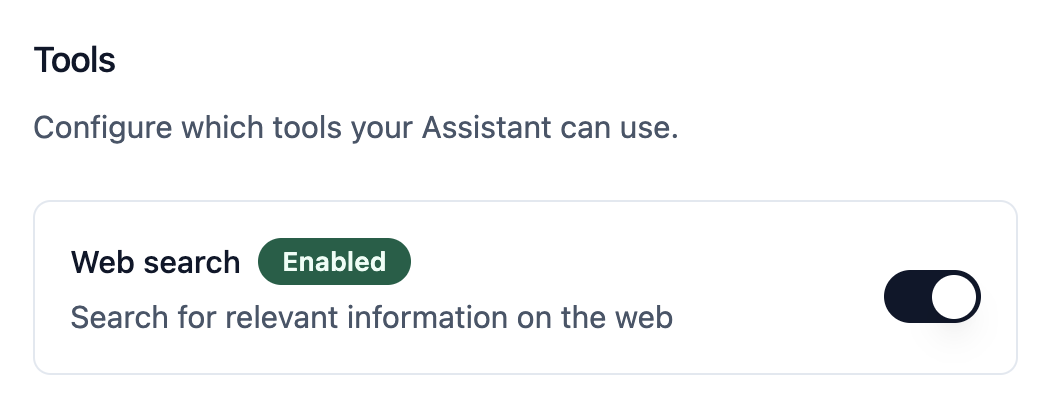 Go to your Assistant's settings and click on **Advanced**
In the **Tools** section, toggle on **Web Search**
Your Assistant can now perform web searches when answering questions
When your Assistant uses web search, it always shows the sources it referenced, regardless of whether you have the [sources feature](/creating/sources) enabled for uploaded knowledge files.
Go to your Assistant's settings and click on **Advanced**
In the **Tools** section, toggle on **Web Search**
Your Assistant can now perform web searches when answering questions
When your Assistant uses web search, it always shows the sources it referenced, regardless of whether you have the [sources feature](/creating/sources) enabled for uploaded knowledge files.
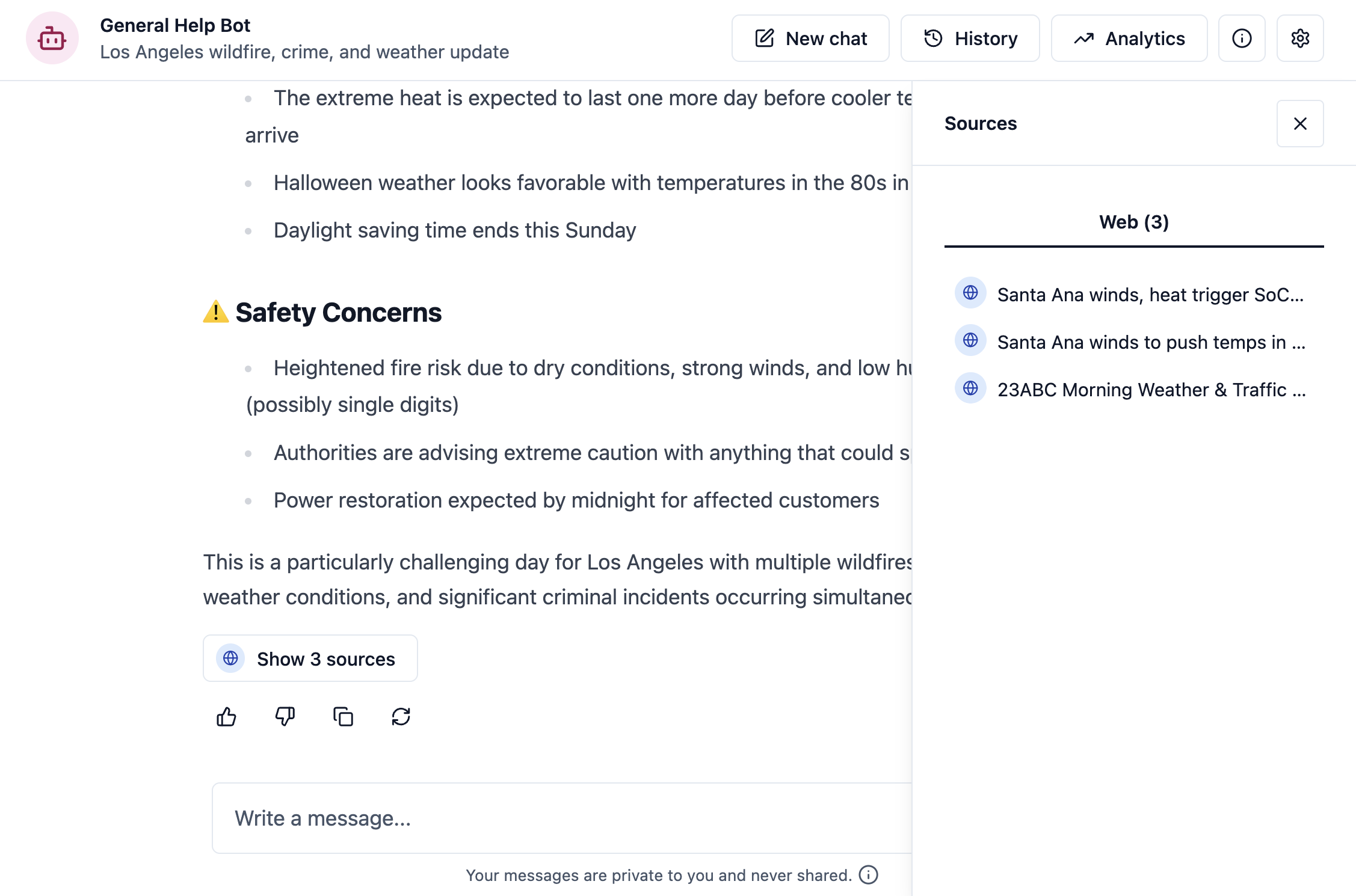 **Sources are automatic for web search**: Unlike uploaded knowledge files where you can toggle sources on or off, web search results always include the links the AI referenced. This helps students verify the information and understand where the data comes from.
Web search works best when combined with your course materials. Your Assistant will reference uploaded documents first, then use web search to supplement with current information when needed.
Tell students that the Assistant can access current information online. This helps them understand the Assistant's capabilities and encourages them to ask questions about recent events or data.
Enable web search for subjects that benefit from current information (sciences, business, current events) but consider disabling it for subjects focused solely on historical texts or specific course materials.
**Why this is more powerful than Google search**: Unlike having students search Google themselves, your Assistant with web search can synthesize current information with your course materials, applying your specific frameworks and theories to real-world events. Students get contextualized analysis rather than just raw data, helping them understand how to apply what they're learning to current situations.
## Quiz
Quiz allows your Assistant to generate and grade interactive quizzes directly within the chat conversation. Students can request quizzes on topics they're learning, answer them interactively, and receive AI-powered grading and feedback without leaving the conversation.
| Quiz Enables ✓ | Quiz Isn't ✗ |
| ----------------------------------------------------------- | ------------------------------------------------- |
| AI-generated practice questions within chat conversations | A replacement for your LMS quiz or test tools |
| Instant AI-powered grading with explanatory feedback | Integrated with your LMS grade book |
| Five question types for diverse practice | Designed for high-stakes summative assessment |
| Student-driven, self-paced knowledge checks | Controlled by instructor like traditional quizzes |
| One-time submission for each quiz (1-20 questions per quiz) | Allows retakes |
**Important**: Quiz is designed as a formative learning tool for student self-assessment and practice, not as a replacement for formal graded assessments. Think of it as an interactive study partner that helps students test their understanding and receive immediate feedback during their learning process.
Enable Quiz for Assistants that support:
* Formative assessment and knowledge checks
* Student self-testing and exam preparation
* Practice reinforcement after reading or lectures
* Interactive learning with immediate feedback
* Self-paced study and concept mastery
Student: "Can you quiz me on cellular respiration with 5 multiple choice questions to help me prepare for tomorrow's exam?"
Student: "Give me a short quiz about the causes of World War I. I want to test what I learned from this week's readings."
Student: "Test my understanding of Python loops with some fill-in-the-blank and short answer questions."
Student: "Create a quiz on the themes in Chapter 3 of The Great Gatsby to check my comprehension."
Consider disabling Quiz if:
* You want to prevent students from using AI-generated practice questions
* Your course requires all assessments to be instructor-created and controlled
* You prefer students to use only your official practice materials
Students request quizzes in conversation; no particular syntax is required. They ask the Assistant to generate a quiz on a specific topic, specify the number of questions (1-20), and optionally request particular question types. The Assistant generates the quiz, presents questions, and provides AI-powered grading with explanatory feedback after submission.
**Student Request**: "Quiz me on photosynthesis with 3 multiple choice questions"
**Quiz Experience**:
The Assistant generates questions with clearly labeled options. Students select their answers, submit the completed quiz, and receive immediate grading with explanations for correct and incorrect answers.
**Feedback Example**:
* Question 1: Correct! ✓ - Explanation of why the answer is right
* Question 2: Incorrect ✗ - Explanation of the correct answer and why their choice was wrong
* Question 3: Correct! ✓ - Additional context connecting to course concepts
**Student Request**: "Give me questions about SQL commands where multiple answers might be correct"
**Quiz Experience**:
The Assistant creates "select all that apply" questions. Students can choose multiple options for each question. Grading evaluates whether they selected all correct answers and avoided incorrect ones.
**Feedback Example**:
* Partial credit for selecting some but not all correct answers
* Explanations for each option (why it's correct or incorrect)
* Guidance on concepts that need review
**Student Request**: "Test my understanding of Newton's laws, and use a mix of fill-in-the-blank and short answer questions"
**Quiz Experience**:
Students type their answers directly. For fill-in-the-blank, they provide specific terms or values. For short answer, they write brief explanations or analyses.
**Feedback Example**:
* AI evaluates answers for accuracy and completeness
* Provides corrections for factual errors
* Suggests ways to strengthen explanations
* Highlights key concepts that were missing
**Sources are automatic for web search**: Unlike uploaded knowledge files where you can toggle sources on or off, web search results always include the links the AI referenced. This helps students verify the information and understand where the data comes from.
Web search works best when combined with your course materials. Your Assistant will reference uploaded documents first, then use web search to supplement with current information when needed.
Tell students that the Assistant can access current information online. This helps them understand the Assistant's capabilities and encourages them to ask questions about recent events or data.
Enable web search for subjects that benefit from current information (sciences, business, current events) but consider disabling it for subjects focused solely on historical texts or specific course materials.
**Why this is more powerful than Google search**: Unlike having students search Google themselves, your Assistant with web search can synthesize current information with your course materials, applying your specific frameworks and theories to real-world events. Students get contextualized analysis rather than just raw data, helping them understand how to apply what they're learning to current situations.
## Quiz
Quiz allows your Assistant to generate and grade interactive quizzes directly within the chat conversation. Students can request quizzes on topics they're learning, answer them interactively, and receive AI-powered grading and feedback without leaving the conversation.
| Quiz Enables ✓ | Quiz Isn't ✗ |
| ----------------------------------------------------------- | ------------------------------------------------- |
| AI-generated practice questions within chat conversations | A replacement for your LMS quiz or test tools |
| Instant AI-powered grading with explanatory feedback | Integrated with your LMS grade book |
| Five question types for diverse practice | Designed for high-stakes summative assessment |
| Student-driven, self-paced knowledge checks | Controlled by instructor like traditional quizzes |
| One-time submission for each quiz (1-20 questions per quiz) | Allows retakes |
**Important**: Quiz is designed as a formative learning tool for student self-assessment and practice, not as a replacement for formal graded assessments. Think of it as an interactive study partner that helps students test their understanding and receive immediate feedback during their learning process.
Enable Quiz for Assistants that support:
* Formative assessment and knowledge checks
* Student self-testing and exam preparation
* Practice reinforcement after reading or lectures
* Interactive learning with immediate feedback
* Self-paced study and concept mastery
Student: "Can you quiz me on cellular respiration with 5 multiple choice questions to help me prepare for tomorrow's exam?"
Student: "Give me a short quiz about the causes of World War I. I want to test what I learned from this week's readings."
Student: "Test my understanding of Python loops with some fill-in-the-blank and short answer questions."
Student: "Create a quiz on the themes in Chapter 3 of The Great Gatsby to check my comprehension."
Consider disabling Quiz if:
* You want to prevent students from using AI-generated practice questions
* Your course requires all assessments to be instructor-created and controlled
* You prefer students to use only your official practice materials
Students request quizzes in conversation; no particular syntax is required. They ask the Assistant to generate a quiz on a specific topic, specify the number of questions (1-20), and optionally request particular question types. The Assistant generates the quiz, presents questions, and provides AI-powered grading with explanatory feedback after submission.
**Student Request**: "Quiz me on photosynthesis with 3 multiple choice questions"
**Quiz Experience**:
The Assistant generates questions with clearly labeled options. Students select their answers, submit the completed quiz, and receive immediate grading with explanations for correct and incorrect answers.
**Feedback Example**:
* Question 1: Correct! ✓ - Explanation of why the answer is right
* Question 2: Incorrect ✗ - Explanation of the correct answer and why their choice was wrong
* Question 3: Correct! ✓ - Additional context connecting to course concepts
**Student Request**: "Give me questions about SQL commands where multiple answers might be correct"
**Quiz Experience**:
The Assistant creates "select all that apply" questions. Students can choose multiple options for each question. Grading evaluates whether they selected all correct answers and avoided incorrect ones.
**Feedback Example**:
* Partial credit for selecting some but not all correct answers
* Explanations for each option (why it's correct or incorrect)
* Guidance on concepts that need review
**Student Request**: "Test my understanding of Newton's laws, and use a mix of fill-in-the-blank and short answer questions"
**Quiz Experience**:
Students type their answers directly. For fill-in-the-blank, they provide specific terms or values. For short answer, they write brief explanations or analyses.
**Feedback Example**:
* AI evaluates answers for accuracy and completeness
* Provides corrections for factual errors
* Suggests ways to strengthen explanations
* Highlights key concepts that were missing
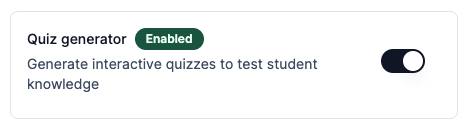 Go to your Assistant's settings and click on **Advanced**
In the **Tools** section, toggle on **Quiz**
Your Assistant can now generate and grade quizzes when students request them
**Quiz as a learning tool**: Quiz is designed as a conversation-based study partner for formative learning. Students can take a quiz, review feedback, study more, then test themselves again in a new conversation. This active learning cycle helps them identify knowledge gaps, reinforce concepts, and build confidence before exams.
You can also customize quiz behavior in your Assistant's prompt — for example, specifying preferred question types, number of questions per quiz, or topics to focus on.
***
## Nectir Support Tool
The Nectir Support tool lets your Assistant search [Nectir's support documentation](https://support.nectir.io) to answer questions about the platform in real-time.
Your Assistant always accesses the latest support documentation—no manual updates needed.
**What it's for:**
* Real-time access to all Nectir support documentation
* Answers questions about platform features, setup, and best practices
* Seamless in-conversation help without leaving the chat
**What it's not:**
* A replacement for human support (complex issues, bugs, account problems)
* For answering your course-specific content questions
* Enabled by default
Enable this tool when you want your Assistant to help users learn how to use the Nectir platform itself.
**Recommended for:**
* Institutions with many first-time Nectir users
* Assistants designed for general student support
* Pilot programs where users are still learning the platform
* Any Assistant where users might ask questions about how Nectir works
**May not need it:**
* Highly specialized Assistants where users are already platform-savvy
* Mature deployments where support questions are rare
As a **Workspace owner** or **Assistant owner**, go to the Assistant's **Settings** page.
Select the **Advanced** tab, then scroll to the **Tools** section.
Toggle on **Nectir Support** and save your changes.
Your Assistant can now search Nectir's support documentation when users ask platform-related questions.
* Enable this tool on general-purpose Assistants in environments with new Nectir users
* This tool adds Nectir platform knowledge on top of your Assistant's normal capabilities — it doesn't limit the Assistant to only answering platform questions
For complex issues, account problems, or bugs, direct users to [support@nectir.io](mailto:support@nectir.io).
***
## Video Tutorial
Watch how to select AI models and configure temperature settings
Go to your Assistant's settings and click on **Advanced**
In the **Tools** section, toggle on **Quiz**
Your Assistant can now generate and grade quizzes when students request them
**Quiz as a learning tool**: Quiz is designed as a conversation-based study partner for formative learning. Students can take a quiz, review feedback, study more, then test themselves again in a new conversation. This active learning cycle helps them identify knowledge gaps, reinforce concepts, and build confidence before exams.
You can also customize quiz behavior in your Assistant's prompt — for example, specifying preferred question types, number of questions per quiz, or topics to focus on.
***
## Nectir Support Tool
The Nectir Support tool lets your Assistant search [Nectir's support documentation](https://support.nectir.io) to answer questions about the platform in real-time.
Your Assistant always accesses the latest support documentation—no manual updates needed.
**What it's for:**
* Real-time access to all Nectir support documentation
* Answers questions about platform features, setup, and best practices
* Seamless in-conversation help without leaving the chat
**What it's not:**
* A replacement for human support (complex issues, bugs, account problems)
* For answering your course-specific content questions
* Enabled by default
Enable this tool when you want your Assistant to help users learn how to use the Nectir platform itself.
**Recommended for:**
* Institutions with many first-time Nectir users
* Assistants designed for general student support
* Pilot programs where users are still learning the platform
* Any Assistant where users might ask questions about how Nectir works
**May not need it:**
* Highly specialized Assistants where users are already platform-savvy
* Mature deployments where support questions are rare
As a **Workspace owner** or **Assistant owner**, go to the Assistant's **Settings** page.
Select the **Advanced** tab, then scroll to the **Tools** section.
Toggle on **Nectir Support** and save your changes.
Your Assistant can now search Nectir's support documentation when users ask platform-related questions.
* Enable this tool on general-purpose Assistants in environments with new Nectir users
* This tool adds Nectir platform knowledge on top of your Assistant's normal capabilities — it doesn't limit the Assistant to only answering platform questions
For complex issues, account problems, or bugs, direct users to [support@nectir.io](mailto:support@nectir.io).
***
## Video Tutorial
Watch how to select AI models and configure temperature settings