Documentation Index
Fetch the complete documentation index at: https://support.nectir.io/llms.txt
Use this file to discover all available pages before exploring further.
Getting Started 🚀
Step 1: Access
Step 2: Interface
Step 3: Privacy
Website Access:
- Go to ai.nectir.io
- Sign in with your email - Nectir AI doesn’t have accounts or passwords, so use either the email that received an invitation or an email you want to use for school tools
- Join an existing workspace (if invited)
- Start using Nectir AI
LMS Integration:
- Log in to your LMS (Canvas, D2L, Moodle, etc.)
- Navigate to the course with Nectir AI
- Click the “Nectir AI” button
- Accept cookies (first time only)
- Start using Nectir AI immediately
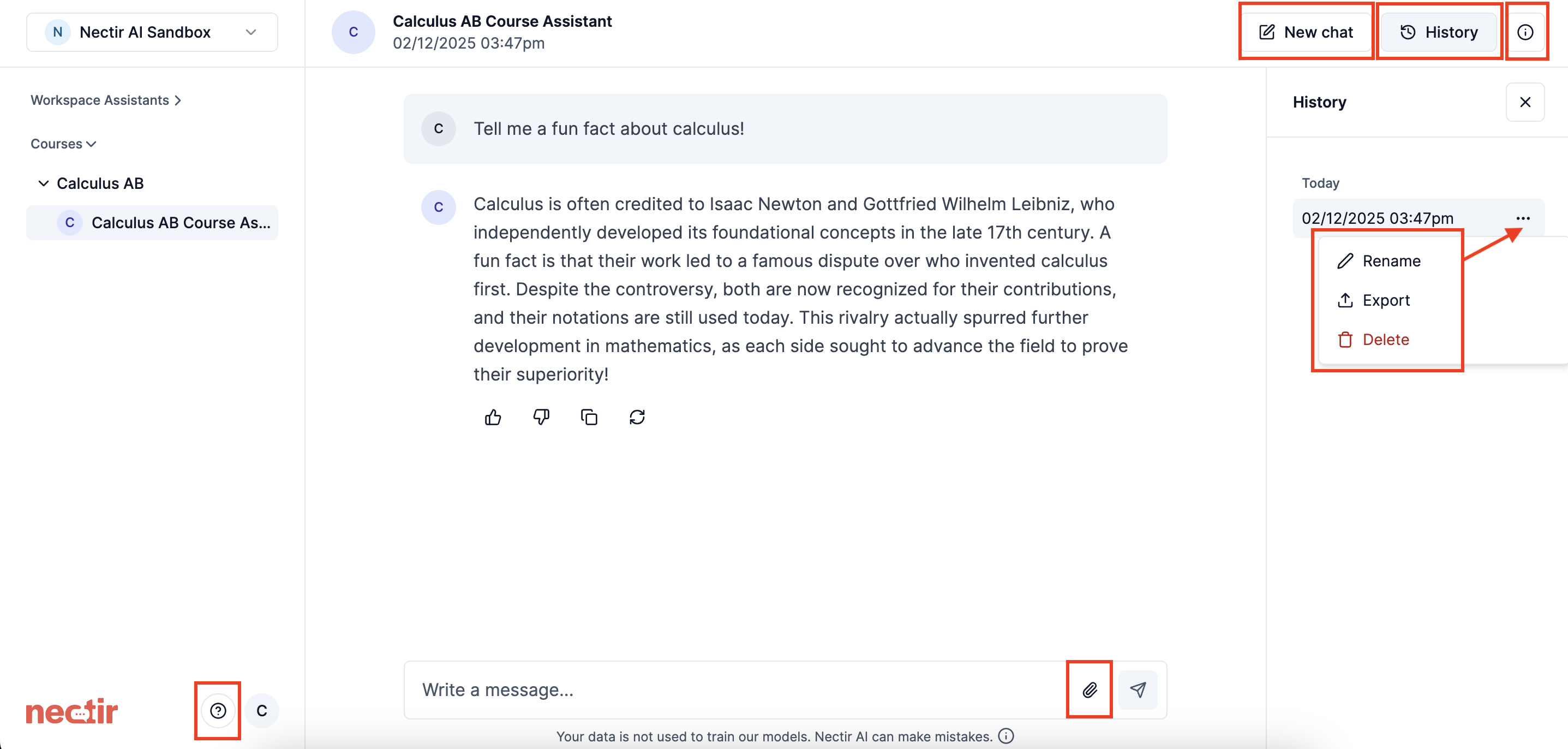
Need more detailed instructions? Complete guide to accessing Nectir AI Key interface features
New Chat
Start a fresh conversation with your Assistant. Each new chat begins without the context of previous conversations.
History
Access, rename, export, or delete your previous conversations. You can also continue any past conversation by clicking on it. Learn more about chat history Info
View the name and description of the Assistant, including what it’s designed to help you with.
Attach
Upload files to provide context to your questions. Supported file types:
- PDF (.pdf) for course materials and documents
- Word documents (.docx) for assignments and papers
- Images (.jpg, .jpeg, .png, .webp) for diagrams, screenshots, or handwritten notes
- Text files (.txt, .text) for plain text content
- Code files (.py, .js, .ts, .html, .css, .sql, .json) for programming assignments
Support
Access help documentation and contact the Nectir support team if you encounter any technical issues or have questions.
Sources
If your instructor has enabled sources, you’ll see a “Sources” section at the end of some Assistant responses. This shows which course files (like your syllabus, lecture notes, or readings) the Assistant used to generate its answer. Click any source to view the original document for more detailed information.
Your conversations are private. Only you can see your chat history with the Assistant.What instructors can see:
- Topic trends: Most frequently asked about subjects (without showing who asked)
- Usage statistics: How many students are using the Assistant and how often
- Common knowledge gaps: Areas where students need the most help (anonymized)
- Response quality insights: Whether the Assistant is providing helpful answers
- They cannot see your individual conversations, questions, or identify who asked what
Your control:Privacy resources:
Ready to Chat? 💬
-
“I just finished reading Chapter [#] about [topic]. Can you summarize the main points so I can check my understanding?”
-
“We covered [specific topic] in today’s lecture, but I’m confused about [specific part]. Can you explain the key concepts?”
Why this works: Quick comprehension checks help you identify gaps and reinforce key concepts.
-
“I’m working on [assignment type] about [topic]. I understand [what you know], but I’m struggling with [specific challenge]. Can you help me think through this?”
-
“I have an idea about [concept/theory], but I want to make sure I’m on the right track. Can you check my thinking: [your explanation]?”
Pro move: Explaining your current understanding helps the Assistant provide targeted guidance where you need it most.
Examples by Topic 📚
💡 Tip: upload files when helpful
Attach readings, drafts, images, or code files to give your Assistant better context about what you’re working on.
Course Content
Assignments & Papers
Exam Prep
Research Help
When you’re confused about class material:| ❌ Too general: | ✅ Try saying: |
|---|
| “I don’t get it" | "I’m reading about photosynthesis but I’m confused about how ATP is made. Can you break this down?" |
| "Help with biology" | "The professor mentioned social constructivism in lecture - what does that actually mean?” |
More examples that work great:
- “I understand the basic concept of [topic], but how does [specific part] actually work?”
- “Can you explain [concept] using an analogy or real-world example?”
- “What’s the connection between [topic from Week 2] and what we’re learning now?”
When you’re stuck on assignments:| ❌ Don’t ask: | ✅ Ask instead: |
|---|
| “Write my essay" | "I need to write about climate change policy. How should I organize my argument?" |
| "Do my homework" | "What are the key elements I should include in this type of analysis?” |
Great assignment questions:
- “I’m stuck on how to start my essay about [topic]. What approach would you suggest?”
- “Can you help me understand what the professor wants when they ask for ‘critical analysis’?”
- “I have three main points for my paper. How should I organize them effectively?”
- “What questions should I be asking myself while analyzing this [data/text/case study]?”
When preparing for tests:| ❌ Avoid: | ✅ Ask: |
|---|
| “Tell me everything for the exam" | "Can you quiz me on [specific topic] to see if I understand it?" |
| "What will be on the test?" | "I’m struggling with [concept]. Can you give me practice problems?” |
Effective study questions:
- “Based on our course materials, what are the most important concepts I should focus on for [topic]?”
- “Can you create some practice questions about [specific chapter/unit]?”
- “I keep getting confused between [concept A] and [concept B]. Can you help me see the differences?”
- “Let’s do a study session - ask me questions about [topic] and tell me if my answers are correct”
Interactive Quiz feature: If your instructor has enabled Quiz, you can request interactive quizzes with multiple question types (multiple choice, true/false, multiple select, fill in the blank, and short answer). Just ask: “Quiz me on [topic] with [number] questions” and you’ll get instant AI-powered grading with feedback to help you learn!
When working on research projects:| ❌ Too broad: | ✅ Be specific: |
|---|
| “Find sources for my paper" | "I’m writing about the impact of social media on teen mental health. What types of sources would be most credible?" |
| "How do I research?" | "How should I organize my research paper about renewable energy policy?” |
Research questions that work:
- “What’s the difference between primary and secondary sources for this type of research?”
- “I found some information about [topic], but how do I evaluate if this source is reliable?”
- “Can you help me create an outline for my research paper on [specific topic]?”
- “What are the key arguments I should address when discussing [controversial topic]?”
Need Help? 🆘
Having technical issues? Visit the troubleshooting guide or contact your instructor for course content questions.