
Discover the new Assistant Builder
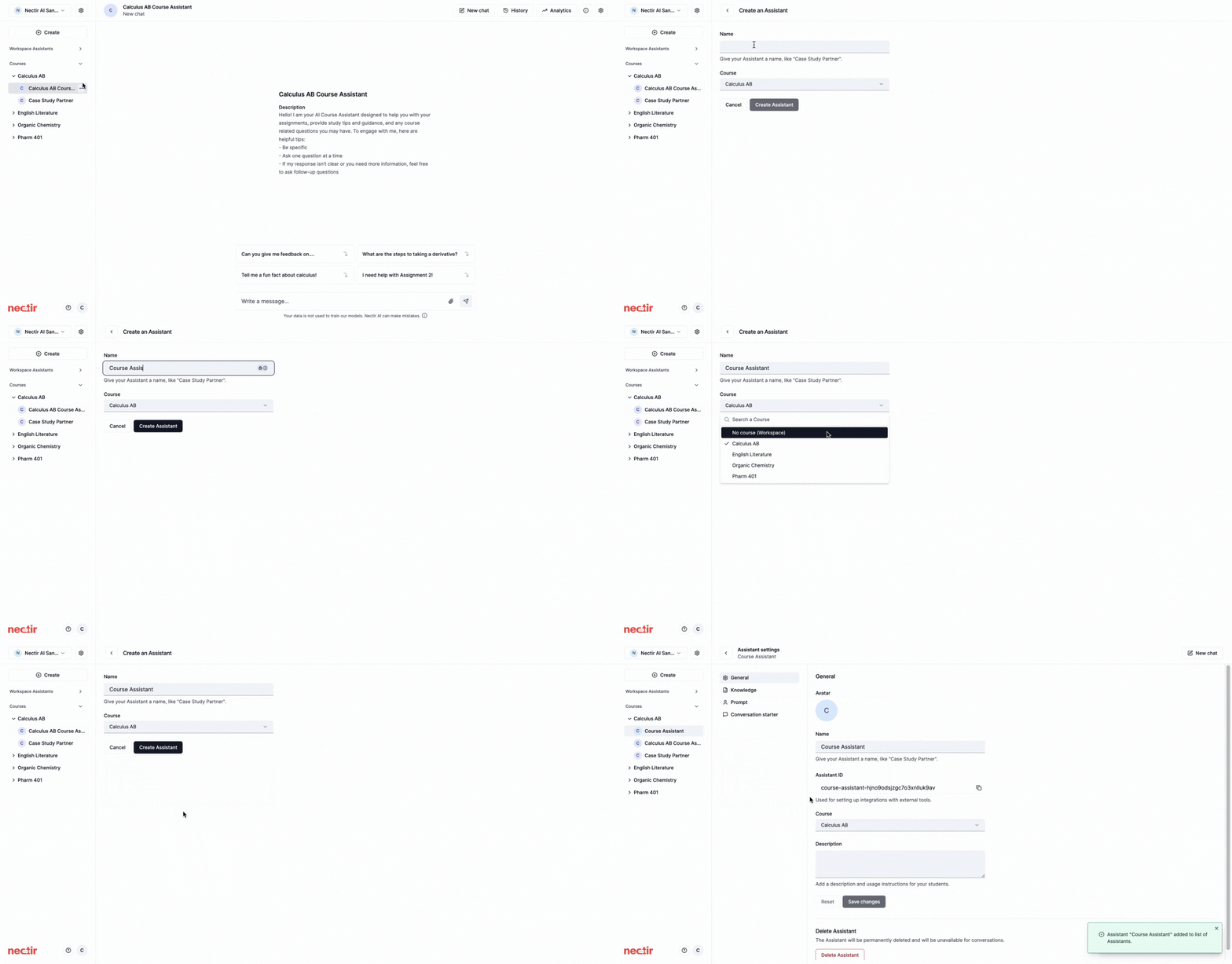
Create an Assistant by describing it. You can create or edit an Assistant just by describing what you want. The Assistant Builder turns your description into a complete Assistant with a name, description, prompt, and conversation starters, then asks follow-up questions to help you refine it.Step 1: Access the Creation Menu
For Workspace Owners and Editors
For Workspace Owners and Editors
- Click Create on the top left in the sidebar
- Select Create Assistant
- Workspace Owners can create an Assistant at the Workspace level or within any Group. Editors can create one in their Private space or within a Group they own
For Group Owners
For Group Owners
- Hover over your Group name
- Click the ellipsis that appears
- Select Create Assistant
- Group owners can only create Assistants within their own Groups
- If you need to create a new Group and don’t have sidebar access, contact your Workspace administrator
Step 2: Configure Basic Settings
- Enter a descriptive name that reflects the Assistant’s purpose
- Choose where to make your Assistant available:
- Shared with everyone - Available to all Workspace users
- Note: Only Workspace Owners can create “Shared with everyone” Assistants
- Group - Add to an existing Group that’s already “Shared” or in your “Private” space
- Learn more about Group types
- Shared with everyone - Available to all Workspace users
- Click Create to proceed to customization
Understanding Assistant Visibility: Assistants placed within a Group are visible to all members of that Group. For LMS-linked courses, students will see any Assistants in the linked Group when they access Nectir AI. You can control visibility at any time by moving Assistants in or out of Groups - removing an Assistant from a Group will hide it from users, and you can add it back later to make it visible again.
Step 3: Customize General Settings
Best practices for writing effective descriptions:
- Introduce the Assistant’s purpose: Explain what the Assistant is designed to help with
- Provide usage instructions: Give specific examples of questions users can ask
- Set expectations: Explain what the Assistant can and can’t do
- Include guidelines: Share any rules or boundaries for appropriate use
- Use clear, conversational language: Write as if speaking directly to your students
Managing Assistants
Edit an Assistant
Edit an Assistant
Return to an Assistant’s configuration to change its name, description, knowledge, prompt, or any other setting. Use this if you had to close the page mid-setup and want to pick up where you left off.How to edit:
- Hover over the Assistant name in the sidebar
- Click the three dots that appear
- Select Settings
- Update any setting and save
The Assistant exists as soon as you complete Step 2, so it stays in the sidebar with the settings you saved. Changes you didn’t save before closing the page are lost.
Duplicate an Assistant
Duplicate an Assistant
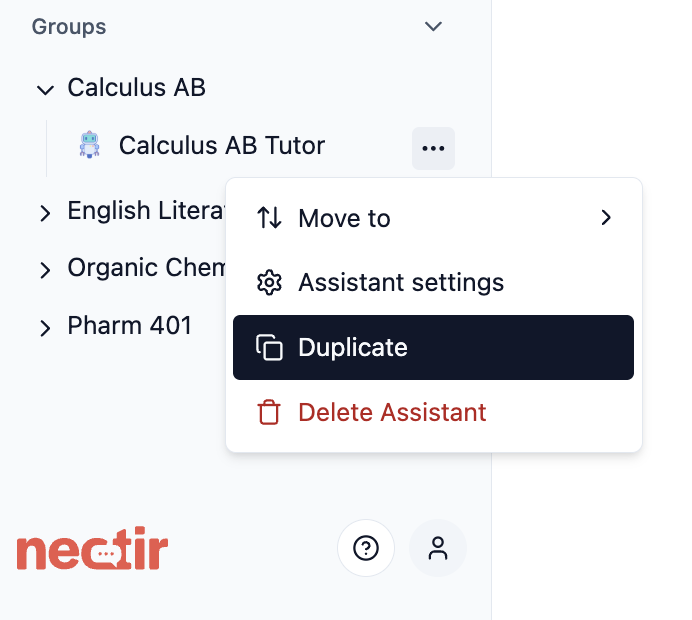
Create a copy of an existing Assistant with all the same settings and configurations.How to duplicate:
- Hover over the Assistant name in the sidebar
- Click the three dots that appear
- Select Duplicate
- Click Duplicate in the confirmation dialog. The system creates a copy in the same Group with “Copy” appended to the name
- Create variations with minor differences
- Test new configurations without affecting the original
- Deploy similar Assistants across different Groups
- Keep a backup before making major changes
Move an Assistant
Move an Assistant
Transfer an Assistant from one Group to another to change access permissions.How to move:
- Hover over the Assistant name in the sidebar
- Click the three dots that appear
- Select Move To
- Choose the destination Group from the dropdown
- Transition from private development to public Group
- Reorganize for different semesters or terms
- Change which students or faculty have access
- Consolidate Assistants from different Groups
The Assistant will be transferred with all settings and training data intact.
Delete an Assistant
Delete an Assistant
Permanently remove an Assistant that’s no longer needed.How to delete:
- Hover over the Assistant name in the sidebar
- Click the three dots that appear
- Select Delete
- In the Delete Assistant dialog, type the text it asks for and click Delete
Next Steps
Assistant Knowledge
Define what information your Assistant can access
Assistant Prompt
Set the directions that shape your Assistant’s behavior
Add to a Canvas Course
Put your Assistant in front of students in the course sidebar, a page, an assignment, or a module
Video Tutorial
Watch the Complete Walkthrough
See the entire Assistant creation process from start to finish